

The Maniq Living Heritage Forum 2026 aims to create an inclusive space for the public to learn about and better understand the Maniq ethnic community through diverse perspectives. At the heart of the forum is the principle of learning directly from community members and people with lived experience, alongside academic knowledge, to promote cultural understanding and respect for the Maniq people’s way of life, traditional knowledge, and relationship with the forest.
Rather than presenting the Maniq community solely as a subject of academic study, the forum emphasises listening to the voices of the people whose stories are being told. It seeks to connect research, culture, community experience, and public learning while encouraging dialogue based on respect for cultural diversity and human dignity.
One of the key highlights is the Living Museum, an interactive learning space that allows participants to explore Maniq ways of life and traditional knowledge through direct engagement. Moving beyond conventional museum displays, the Living Museum focuses on communication, participation, experience, and storytelling as essential elements of learning about living cultural heritage.
The event will also feature an exhibition of photographs, traditional tools and utensils, and creative works by Maniq children. These exhibits provide meaningful insights into everyday life, creativity, and community perspectives through objects and works created within the community.
Interactive learning activities, including educational games, introductions to the Maniq language, and QR Learning, have also been designed to make knowledge accessible to participants of different ages and backgrounds in an engaging and enjoyable way.
Another major programme is the Documentary Talk, featuring a screening of “Maniq: Stories from the Banthat Mountains”. The session will provide an opportunity for participants to engage in dialogue with the documentary director and community representatives, offering perspectives, experiences, and behind-the-scenes stories that may extend beyond what can be communicated through the documentary alone.
The forum will further feature academic discussions addressing important issues related to the Maniq community from multiple perspectives, including ethnic studies, indigenous knowledge, ethnobotany, community rights, and environmental justice.
Scholars, researchers, community representatives, and academic networks from Thailand and abroad will join the discussions, creating opportunities for participants to exchange knowledge and explore the complexities surrounding culture, natural resources, community rights, and social change.
Through these activities, the Maniq Living Heritage Forum 2026 seeks to bridge the gap between academic knowledge and the lived experiences of communities. It encourages participants not only to observe or study the Maniq people, but also to listen, engage, question assumptions, and learn from the people who carry and continue to develop their own cultural knowledge.
The forum therefore represents more than an academic conference or cultural exhibition. It is a space for “listening” and “learning together”, where community voices are placed at the centre of the conversation and where different forms of knowledge can meet on the basis of mutual respect.
By bringing together communities, researchers, educational institutions, museums, and international academic networks, the event aims to foster a deeper understanding of the Maniq people while contributing to discussions on cultural diversity, community rights, environmental stewardship, and the future of living heritage.
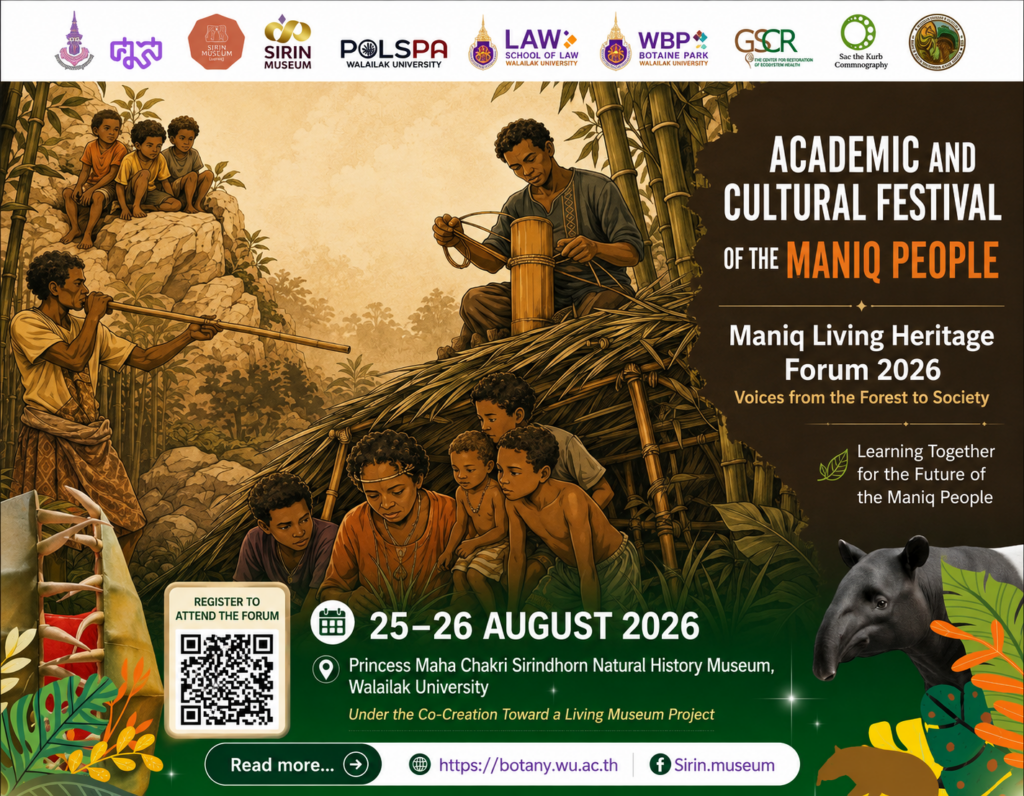
The Maniq Living Heritage Forum 2026 will take place on 25–26 August 2026 at SIRIN MUSEUM, Princess Maha Chakri Sirindhorn Natural History Museum, Walailak University, Nakhon Si Thammarat.
Participants may register via the QR Code provided on the official event poster.
For further information, please contact SIRIN MUSEUM at 081-970-0773.
Join us in listening to the “voices of the storytellers themselves” and discovering new perspectives on the Maniq people through research, culture, community knowledge, and living learning experiences.
Facebook Comments Box